
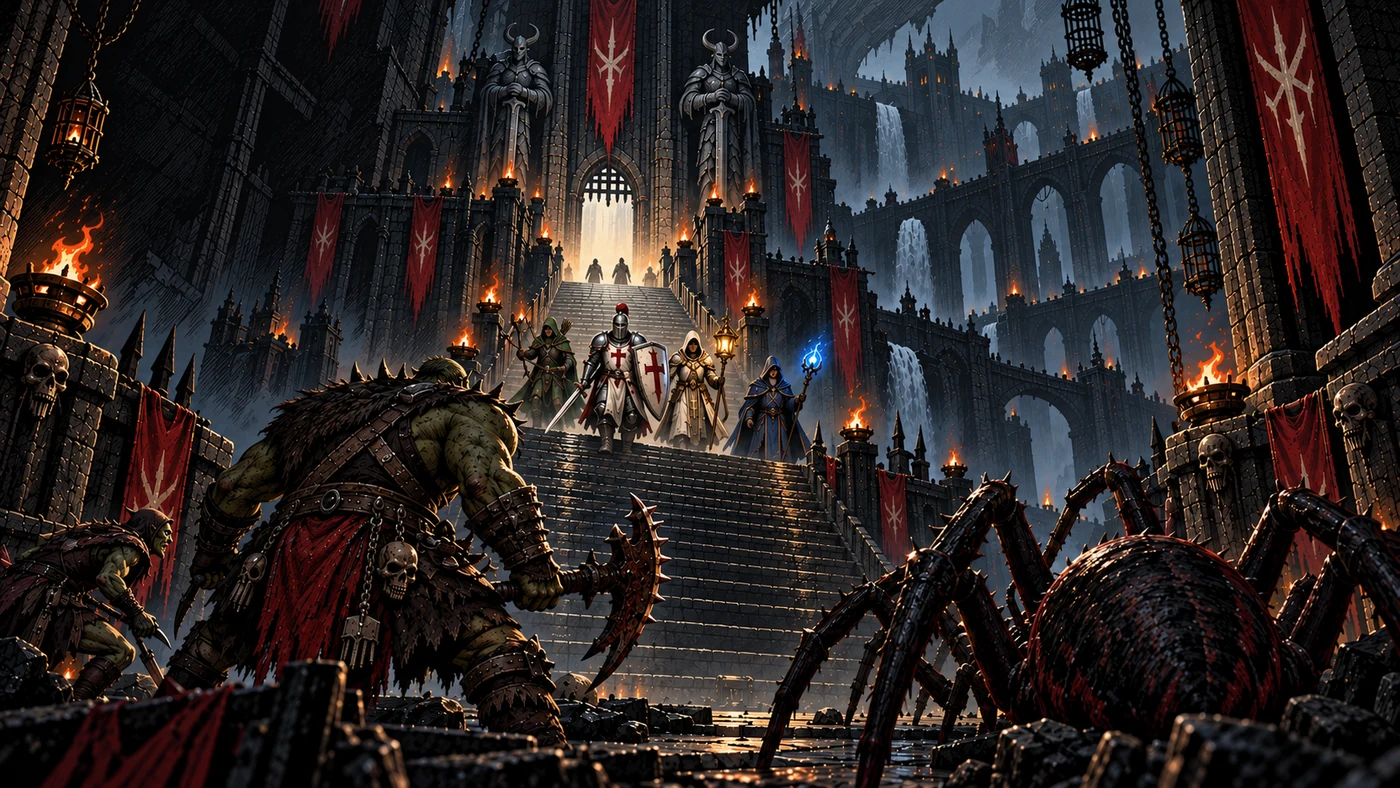
Before asking people to test REIGN, we need the game to make its own questions understandable. What is this run asking you to defend? What did a purchase change? Why did the crusade get through?
Recent development has focused on the path between those decisions: selecting a challenge, preparing a garrison, following the invasion across rooms, and seeing the outcome clearly. That work is now supporting preparation for a controlled Steam Playtest.
A challenge the player chooses
The Crusade Tier redesign replaced automatic difficulty advancement with an explicit selection before the run. Clearing a tier opens the next one. Earlier unlocked tiers remain available, and a defeat does not remove them.
The initial Playtest design covers Tier I through Tier III. Stronger invaders and greater rewards give progression a visible shape. Creature and Gambit unlocks add roles as that challenge develops, while preparation and results explain the reward tradeoff when you use stronger forces in an easier crusade.
That makes progression something a player can inspect and choose. It also gives us better questions to ask about pacing: whether the next tier feels worth attempting, whether a new purchase helps, and whether the rewards make sense.
Clearer preparation and consequences
A catalogue is only helpful if it reflects what can actually be bought and fielded. Our recent interface work has refined roster browsing, purchase selection and the information needed to prepare a garrison.
The battle flow has also received attention. The same invading expedition must be carried into the next room with its surviving members and health state. Completed-room rewards should be resolved before the next preparation step. Health and combat feedback need to help the player follow what happened, especially when movement and several abilities overlap.
These are connected problems. An unclear outcome makes the next purchase harder to judge. An unclear purchase makes it harder to know whether the formation was sensible. We want the run to leave you with a decision you can reconsider, rather than a result you cannot explain.
What simulation can tell us
We have been comparing armies, progression states and purchasing approaches through the game's native combat runtime. Shared starting conditions let us examine how a change affects attrition, rewards and the value of different choices.
That work has helped identify issues such as the strength of cheap packs and the relationship between lasting progression and combat pressure. It has also supported checks that injuries and casualties remain consistent throughout the invasion.
A scripted policy still does not play like a person. It cannot tell us whether a reward screen is clear, whether combat feels tense or whether a strategy is enjoyable to repeat. Technical checks and simulation prepare the candidate for testing; player experience has to answer the remaining questions.
An optional way to report back
The candidate being prepared for the Playtest includes a SEND FEEDBACK action on the main menu. It opens the Double X Games feedback page when you choose to use it. It does not automatically send logs or save files, and it does not interrupt every run with a prompt.
The menu also displays the configured build version and lets you copy it. Including that version helps us understand which candidate a report describes. You decide what to share.
This website now gives that conversation a permanent public home. The journal explains the design work, while the roadmap sets out the direction we are working towards. Future development previews are labelled separately from the initial Playtest scope.
The current position
REIGN remains in development. We are preparing the initial Windows Playtest candidate for a controlled Steam Playtest; public access has not yet been announced. Access details will follow when the relevant pages and distribution are configured and verified. There is no announced release date.
The useful feedback will include more than bug reports. We need to know where a choice became unclear, when a creature felt worth its cost, and whether a defeat suggested a different defence to try. Those are the observations that will help shape the next development pass.