
Winning a run should open a door. It should also leave you free to decide when to walk through it.
That principle drove our recent Crusade Tier redesign. An earlier progression model advanced difficulty automatically after consecutive victories. The initial Playtest design now lets you select the challenge before beginning a run, while keeping every unlocked lower tier available. This describes the candidate we are preparing; public Playtest access has not yet been announced.
Clear a tier, choose the next
A new profile begins with Tier I. Your first successful defence at that tier unlocks Tier II. Clearing Tier II unlocks Tier III. A Tier III clear completes the demo's progression.
Unlocking the next tier does not start it for you. Your selection is remembered, and beginning another crusade remains an explicit choice. Losing does not take an unlocked tier away.
That leaves room for several useful reasons to replay. You might want to try a different formation, learn a creature's role, recover from a difficult run or see how an earlier crusade responds to a newly acquired option. Difficulty should support that experimentation.
A stronger force at the gate
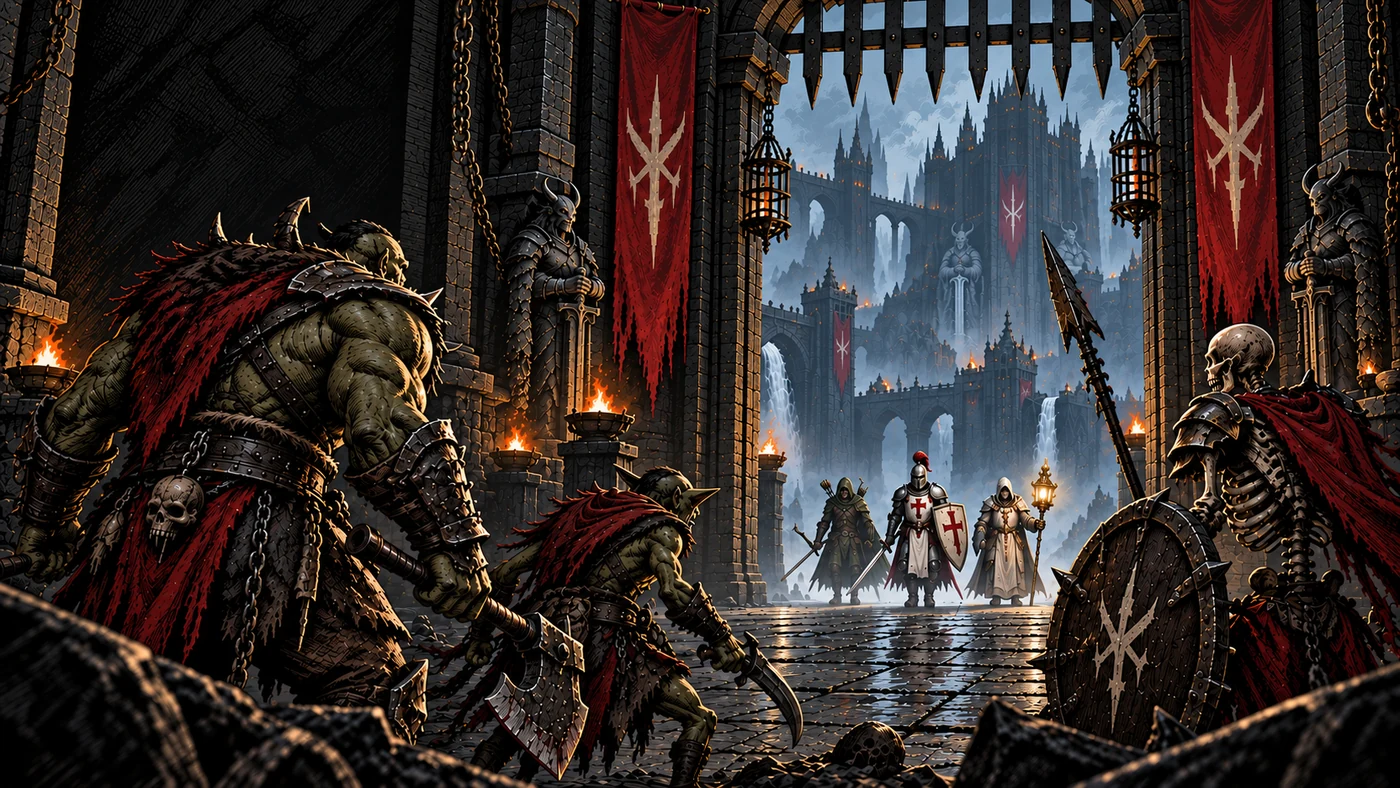
The first three tiers change the invading party itself. Tier I establishes the core combination of Knight, Ranger and Cleric. Tier II adds another Knight, making the front line harder to deal with. Tier III introduces a Rogue alongside that reinforced party.
The change is more than a larger health bar. Another front-line hero can give the ranged attacker more time. A specialist adds a different threat to account for when placing support or arranging a flank.
Each party remains one persistent crusade through the dungeon. Harder difficulty changes what arrives at the entrance; room transitions carry forward the condition of the same invaders.
Progression adds roles
The creature roster and Gambits have their own places within these three tiers.
Tier I begins with the foundation: Goblin Cutters, Kobold Skirmishers and Skeletons, with the Kobold Slinger available to purchase. Tier II opens support, control and hunting through the Goblin Shaman, Giant Spider and Dire Wolf. Tier III adds the Orc Marauder, Hobgoblin Captain and larger late-demo options.
Gambits also broaden as tiers unlock, from the early Reinforce and Terrify choices to further tools such as Curse and Drain. These are purchases and tactical options, rather than a promise that the next run will automatically contain every newly unlocked creature.
We want the sequence to teach new relationships. A support creature raises questions about who protects it. A controller changes which enemy you can pressure. A heavy defender asks how much of the room's budget you are willing to commit to one part of the formation.
Rewards should explain the tradeoff
Harder crusades offer greater Challenge Rewards. Souls support further purchases, while Dread records your growing reputation. The rewards are shown during preparation and broken down after the run.
You can still use owned higher-tier forces against an easier unlocked crusade. Doing so reduces its Challenge Rewards. The reduction follows the stronger creatures actually fielded and the relevant Gambits actually used; merely owning them does not reduce a run's payout.
That keeps an easier run available while giving a reason to accept a more demanding fight. The interface needs to make the tradeoff clear before you commit, so preparation includes reward previews as well as costs and incoming composition.
The boundary of the demo
Tier IV and Tier V are visible but locked in the initial demo design. Work beyond Tier III is a development exploration, described in What's beyond the demo?. It is not an announcement of additional public Playtest access or a fixed launch structure.
Native combat simulations help us compare progression, rewards and the usefulness of different purchases. They cannot decide how difficulty feels to a player. Unlock pacing, reward fairness and the temptation to rely on one strong cheap army remain questions for human testing.
The next useful result is a player choosing a harder crusade because they want to try it, understanding the risk, and still having somewhere familiar to return.