
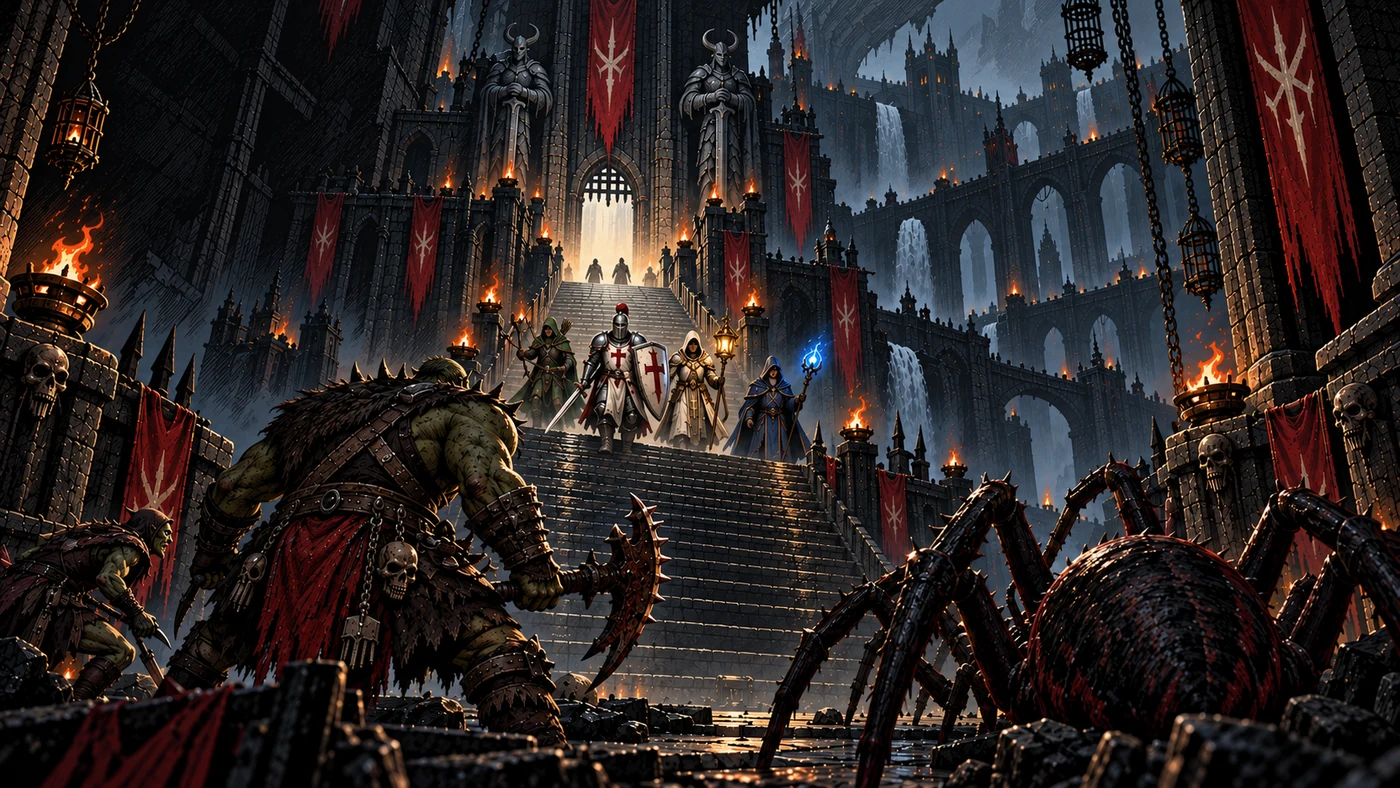
Your first garrison falls. The heroes reach the next room. But the ranger they brought to the gate has been slain, and their knight has already taken a beating.
That is a very different second fight from facing another untouched party. It is the reason REIGN's current four-room structure follows one invading crusade from the entrance to the Last Gate.
The invasion remembers
The crusade is assembled at the beginning of the run. Its surviving members continue from room to room with persistent identities, health and casualty records. A new room does not replace a dead hero with a fresh copy, or restore an entirely new party to full strength.
Healing abilities and limited recovery can change a survivor's health. The important distinction is that the expedition's history remains relevant. It is still the knight you fought earlier, with the consequences of those battles, rather than a new knight standing in for the same class.
This gives each garrison a job within a longer defence. One room might stop the crusade outright. Another might remove a dangerous support hero or leave the survivors vulnerable to what comes next. Damage and casualties have value beyond the battle in which they happen.
Losing a room is not losing the reign
The invaders have to keep moving. If your defenders are overcome in an early room, the surviving crusade pushes deeper. Your next garrison has another chance to stop it.
If you destroy the invading force before it reaches the end, your defence has succeeded. You do not need to let the crusade visit all four rooms to win. If it survives and breaches the Last Gate, the run is lost.
Those outcomes give the rooms a shared story without requiring a scripted battle. A narrow survival in the first fight may leave the crusade unable to finish the descent. A seemingly comfortable defence may unravel if the wrong invader makes it through.
The dungeon's defenders are organised as room-specific garrisons. You are preparing successive positions against the same expedition, rather than marching one surviving monster party through the whole dungeon. That distinction matters when deciding where to spend and how to respond to the remaining heroes.
Preparation is the command
Before committing a formation, you choose your defenders and place them on the battlefield. A front line needs to make contact. Ranged creatures need useful positions. Support needs allies it can help and enough protection to keep doing so.
Once battle begins, the creatures act through their combat behaviours. Your choices are tested by movement, targeting, attacks and the abilities on both sides. Gambits provide limited interventions, but you do not direct every individual action.
That makes the preparation phase consequential. A creature can be powerful on its own and still be poorly suited to the job you have given it. A less expensive pack can matter because several bodies occupy space and create more opportunities to act. The condition of the approaching crusade changes what each room needs to answer.
Making that history visible
Persistence has to be readable. If a slain hero appears healthy in the next room, the player's understanding breaks even if a hidden calculation is correct.
Our recent development work has therefore connected the expedition's state to the room transition and presentation: which invaders are still alive, how much health they have, and what the next garrison is actually facing. Health readouts, reward flow and the pause for preparing the next room all support that same purpose.
We are still evaluating pacing, balance and how clearly the battle communicates its decisions. The lasting aim is simple: every room should feel like part of your response to one invasion.
Building the Crusade Tiers explains how the force at the gate becomes stronger when you choose a harder challenge.