
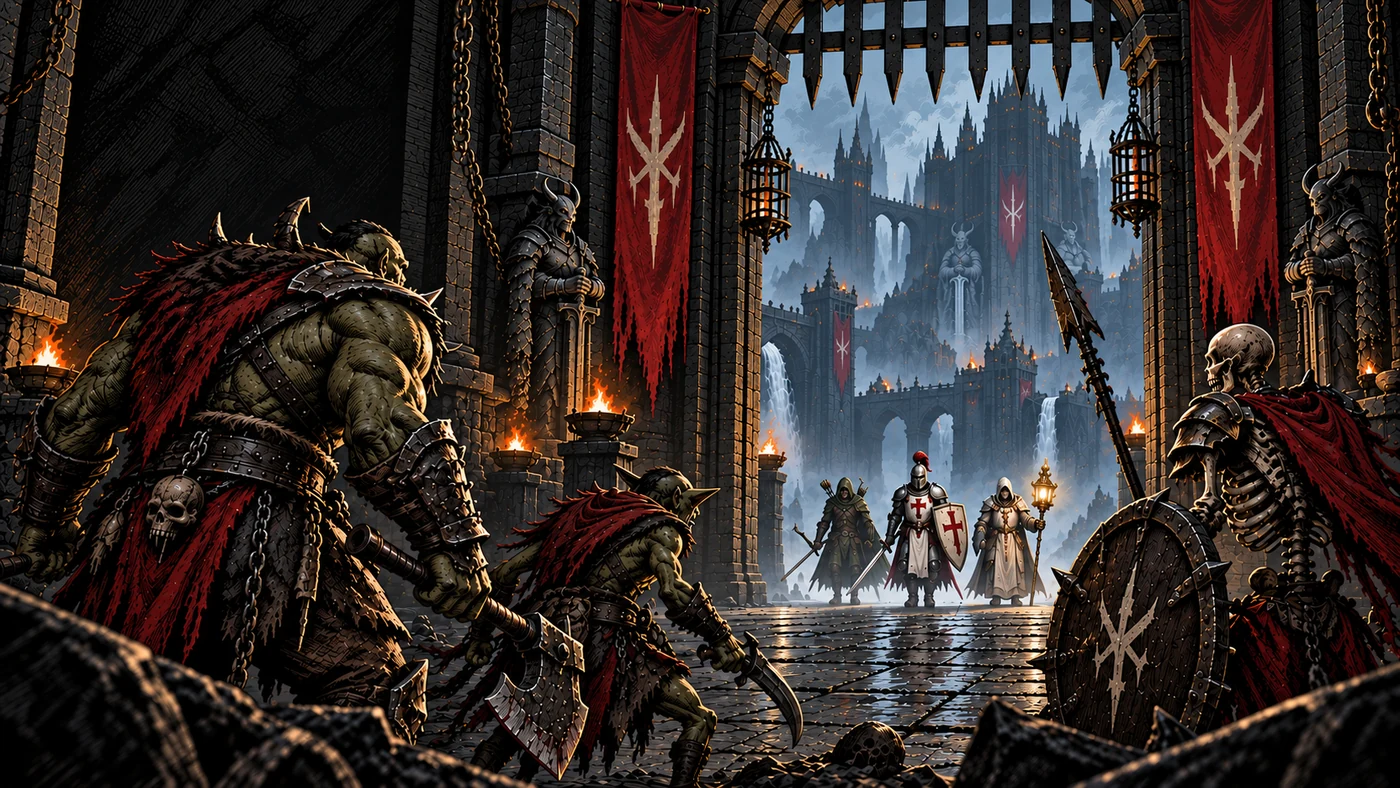
A battle can follow every rule and still leave you wondering what happened. In REIGN OF THE NAMELESS, that matters because the most important decisions happen before the fighting starts. You choose who will defend the dungeon, decide how to spend each room’s budget and place a formation. Once the heroes arrive, the battle unfolds automatically. You need to be able to connect that preparation with what happens next.
That is where much of our recent work has gone: making the dungeon defence easier to understand, while giving the starting roster more room for different plans.
Six ways to begin a defence
The current demo candidate starts with six accessible Tier I choices: Goblin Cutter, Giant Rat, Skeleton Spearman, Skeleton Crossbowman, Kobold Skirmisher and Kobold Slinger.
Those names should mean more than six different portraits. A group of Cutters brings a different threat from a ranged Crossbowman. Rats can spread disease, Cutters can poison their targets, and Spearmen can put pressure on morale. Room budgets and group limits mean you still have to choose what fits your defence. Taking more bodies is a different commitment from protecting a ranged group or combining defenders with an existing family or pack bonus.
The Garrison is where those choices begin. Its invader preview helps you inspect the heroes coming towards your rooms before you commit. We want that moment to feel like preparing for a particular threat, with enough information to try a plan and learn from the result.
Following the fight
Ranged attacks are an important part of that explanation. Bolts, arrows, stones and the Cleric’s effects now have more distinct treatments, so there is a clearer connection between the attacker and the target. The aim is to help you follow an exchange without covering the battlefield in effects.
Character presentation has needed attention too. We corrected the Skeleton Spearman’s walking sequence and worked on how characters move and face their opponents. Targeting and movement refinements help defenders and invaders respond within their existing combat roles. These are improvements to the battle you watch, while your formation remains the decision you make before it begins.
Health displays are another balancing act. You need to see when someone is hurt, but a health bar over every uninjured combatant adds noise. Contextual health bars keep useful information close to the action while leaving more space for silhouettes, attacks and damage feedback. Dense fights still need careful review: a readable individual character does not automatically make a readable crowd.
We have also added subtle dynamic lighting with normal maps on selected character identities. It gives supported characters a little more response to the light around them; it is not a claim that every defender has the same treatment. The lighting option can be switched off in settings.
The next room should remember
The Crusade is one invading force moving through up to four rooms. Surviving invaders carry their wounds forward, without automatic healing between rooms, and losses change who can continue. Healing during a battle can still matter. That makes the next preparation decision depend on what your earlier defenders achieved.
Existing between-room choices, Souls and Dread rewards, and saved progression give a run consequences beyond the final blow. We are checking the ordinary journey through those screens as carefully as the combat itself: what you can afford, what a choice changes, and whether you can return to your reign later.
Quality before a bigger campaign
Our focus now is the quality of the demo. We want to keep testing the normal flow, the clarity of preparation, the pace of battles and the reliability of saving and continuing. Larger trailer and screenshot work can wait until the visual direction is steadier.
A free Windows demo is being prepared for Steam. It is not publicly available yet. We will share availability when it is configured and verified; there is no announced full-game release date or price.
For the current scope, visit the REIGN game page. You can also follow the development roadmap or use our feedback page to get in touch. Those routes will stay current as preparation continues.